





For an art against the cartography of everyday life
2010-10-02 10:35:32 - by
Nicolas Malevé
A beautiful synthesis of the questions surrounding the emergence a few years ago of Locative Media. By Rian Griffis.
«The title of this essay is a remix of the title of an essay by artist Martha Rosler originally published in 1979, “For an Art Against the Mythology of Everyday Life”. Rosler’s text is an engagement with what was then the emerging context now often referred to as “post-industrial globalization.” More specifically, it is an engagement from the perspective of someone attempting to make things – art works – that can “address these banally profound issues of everyday life, thereby revealing the public and political in the personal”. She was particularly interested in both the oppressive and potentially liberating aspects of “mass media.” Here, I want to take up where Rosler left off, discussing the potential of art, and technology, to “step toward reasonably and humanely changing the world” using the example of what is commonly referred to as “locative media.”»
Rian Griffis references a few interesting resources, among others a polemic started from Questioning the Frame a text by Coco Fusco. A good part of the responses are compiled here.
Of interest too is Drew Hemment’s The Locative Dystopia.
Haïti and the importance of open maps.
2010-02-08 11:30:32 - by
Nicolas Malevé
A bit after the fact, but still very interesting information. How Openstreetmap has been used to help NGO’s work in Haiti after the earthquake. A specific webpage has been set up for the occasion: http://www.openstreetmap.org.ph/
A thorough article by Camille Gévaudan, in ecrans.fr (in French).
Other informations in opensource.com
Quick selection of images:
– Map showing the depth of flooding, using OSM road data.

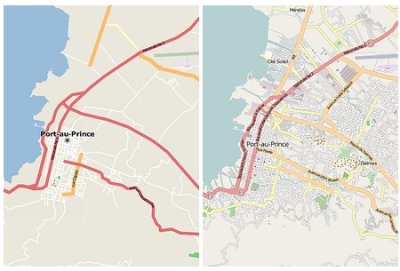
– Port au Prince before and After
The Road Map by Multiplicity
2009-05-28 13:37:26 - by
Antoine Berlon
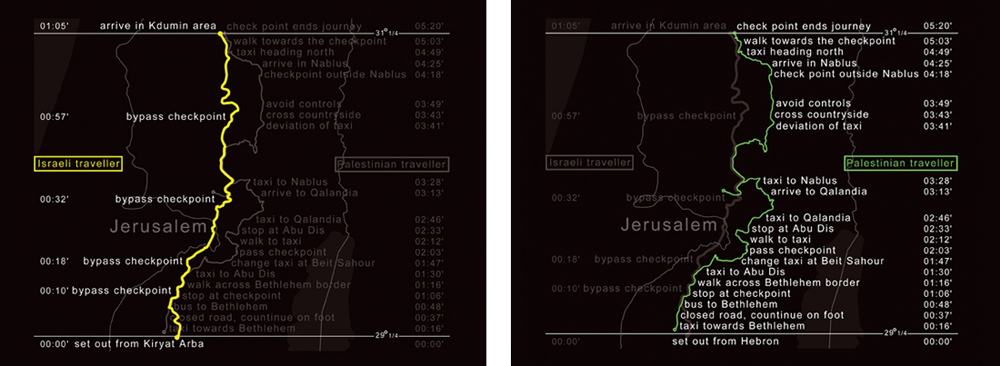
The territories of Israel and Palestine are, in these days, a laboratory of the world. This is a region where, in few acres, an incredible variety of borders, enclosures, fences, chek points, and controlled corridors are concentrated. On january 13th and 14th 2003, we tried to measure with our EU passport, the density of border devices in the surronding area of Jerusalem. On january 13th we travelled on the highway 60, along with a person with an Israeli passport from the colony of Kiriat Arba to the colony of Kudmin. The following day, we travelled allong with a person with a Palestinian passport from the city of Hebron to the city of Nablus. The two routes both start and end in the same latitude ; at some points they overlap. Their travelling times are profoundly different...
See more here
Cherry Blossoms- When war comes home
2009-05-06 17:05:39 - by
Antoine Berlon
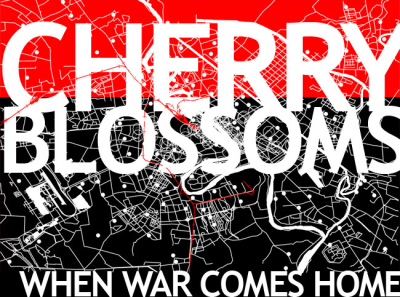
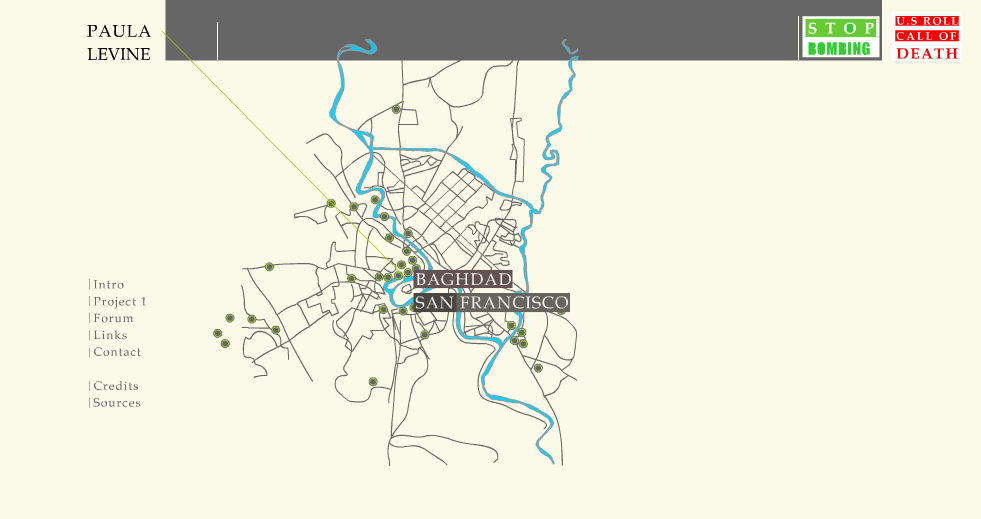
Le projet Cherry Blossoms (2007) d’Alyssa Wright témoigne, avec le projet « Dead in Irak » de Joseph Delappe, d’un certain activisme outre-atlantique consistant à déplacer le monde de la guerre là où on ne l’attend pas, en faisant entrer en collision le quotidien des civils irakien vivant à Bagdad avec l’univers du promeneur dans la ville de Boston, aux Etats-Unis, pour le premier, et avec l’univers des jeux vidéos pour le second.
S’inspirant d’un mashup cartographique de l’artiste Paula Levine (Illustration 2) superposant la carte de Bagdad à celle de San Francisco - et qui n’est pas sans rappeler certaines expériences de dérives situationnistes - Alissa Wright amplifie l’impact du rapprochement des réalités irakiennes et américaines en inscrivant, à Boston, des événements - explosion d’un sac à dos rempli de confettis quand le marcheur rencontre dans son parcours la localisation relative d’un décès (par GPS) suite à un attentat recensé par les informations - dans la marche du visiteur, proposant ainsi une singulière expérience d’ubiquité et d’empathie. Elle espère par là même donner aux citoyens américains une idée plus juste d’une réalité qu’ils sous-estiment - en raison d’un certain contrôle médiatique - à savoir celle des victimes civiles de la seconde guerre du Golfe à Bagdad.
http://www.hyperurbain.org/
Bruxelles CEE
2008-03-25 16:52:37 - by
Rafaella Houlstan-Hasaerts
Françoise Schein, 1992.
Acier, bois, aluminium, objets, journaux, lumières (70x90x25cm). Collection privée. Reproduction courtoisie de l’artiste.
Cette boîte-sculpture présente le plan de Bruxelles modulé par les formes évidées des frontières de chaque pays d’Europe. La signification de l’oeuvre est double. En effet, celle-ci peut être lue comme un clin d’œil à la position fédératrice de Bruxelles dans l’échiquier géopolitique inter-européen : les formes évidées de chaque pays se croisent et se superposent en autant d’ondes de communication. Néanmoins, cette œuvre renvoie également aux disparités linguistiques et culturelles entre ces mêmes pays : dans les bords latéraux de la boîte se trouvent douze lucarnes lumineuses où sont exposées des coupures de presse de chaque nation.
Voir à ce sujet : Marie-Ange Brayer, Le Planétarium urbain de Françoise Schein in +/0 (revue bimestrielle d’art contemporain), numéro 51, octobre 1988.
L’appui de la convivialité et de la sécurité des espaces publics dans la première couronne de Bruxelles
2008-03-24 18:45:52 - by
Rafaella Houlstan-Hasaerts
Christian Dessouroux, 1990-2005.
Jeu collaboratif de la spéculation urbaine à Bruxelles
2008-03-20 16:44:46 - by
Rafaella Houlstan-Hasaerts
Rotor, 2004.
Inspiré par les tactiques citoyennes et les luttes urbaines, Rotor a réalisé un jeu qui permet d’expérimenter et d’essayer des stratégies et des actions qui s’appliquent au monde réel. Prenant comme base Bruxelles, ce jeu oppose deux équipes : les spéculateurs et les citoyens. Les spéculateurs doivent essayer d’imposer leurs règles du jeu (les lois) et peuvent les modifier au cours de la partie, tandis que les citoyens se voient obligés de suivre les règles imposées, tout en essayant de créer des stratégies pour les subvertir, se mobilisant en groupe pour initier des manifestations sur la place publique.
Le tableau de jeu peut être acquis gratuitement et librement sur le site Internet de Rotor (www.rotorrr.org).
Luttes urbaines et conquêtes d’espaces
2008-03-20 16:14:57 - by
Rafaella Houlstan-Hasaerts
Syndicat d’initiatives, 1966-2006.
Cette carte recense différentes luttes urbaines bruxelloises : une collecte des histoires de résistances locales, de recettes et tactiques mises en place par différents habitants, collectifs et associations pour lutter contre des projets d’aménagements du territoire ou des situations de spéculation immobilière mettant à mal des environnements urbains singuliers.
Pour la réalisation de cette carte, Syndicat d’initiatives a accordé un intérêt particulier à la créativité des formes de résistance mises en place par les usagers de ces espaces.
Voir : Syndicat d’Initiatives
